
Revision 4.0.0, 2026-04-12
## Abstract
This specification defines a lightweight data format for representing sensor network objects in Sensor Network Object Notation (SNON). Representations are defined in JavaScript Object Notation (JSON) using the SNON data model. A complex collection of sensor network devices can use SNON for hierarchical and peer-to-peer sensor discovery and inventory to create self-describing graphs of the sensor network topology and the measurement characteristics and values for attached sensors.
## Table of Contents
1. [Introduction to SNON](#intro)<br>
1.1 [What is SNON?](#intro.what)<br>
1.2 [What is SNON for?](#intro.for)<br>
1.3 [Why use SNON?](#intro.why)<br>
1.4 [What does SNON look like?](#intro.examples)<br>
1.5 [How are SNON fragments related?](#intro.related)<br>
1.6 [How are SNON fragments used?](#intro.used)<br>
2. [SNON Data Model](#data)<br>
2.1 [SNON Fragments](#data.fragments)<br>
2.2 [SNON Packs](#data.packs)<br>
2.3 [Common SNON Fields](#data.entity)<br>
2.4 [Value SNON Fields](#data.value)<br>
2.5 [Series SNON Fields](#data.series)<br>
2.6 [Sensor SNON Fields](#data.sensor)<br>
2.7 [Measurand SNON Fields](#data.measurand)<br>
2.8 [Device SNON Fields](#data.device)<br>
2.9 [Location SNON Fields](#data.location)<br>
2.10 [Relationship SNON Fields](#data.rel)<br>
3. [SNON Entity Relationships](#rel)<br>
3.1 [Relationship Model](#rel.model)<br>
3.2 [General Relationships](#rel.general)<br>
3.3 [Related Series Relationships](#rel.series)<br>
3.4 [Custom Relationships](#rel.custom)<br>
4. [SNON Examples](#examples)<br>
5. [SNON Schema](#schema)<br>
6. [SNON Security](#security)<br>
6.1 [Encryption and Signing](#security.encryption)<br>
6.2 [PKI](#security.pki)<br>
7. [SNON Transports](#transports)<br>
7.1 [Serial](#transports.serial)<br>
7.2 [CloudEvents](#transports.cloudevents)<br>
7.3 [MQTT](#transports.mqtt)<br>
8. [SNON License](#license)<br>
9. [SNON Changelog](#changelog)<br>
<hr>
## <a name="intro"></a>1. Introduction to SNON
### <a name="intro.what"></a>1.1 What is SNON?
SNON (Sensor Network Object Notation) is an open and interoperable data representation for sensor network data exchange.
SNON defines a transport-agnostic message-fragment-based data exchange format for interoperable data exchange between sensor network devices, such as sensors, edge devices, gateways, processing devices, control systems, databases, historians, dashboards, visualization and reporting engines.
### <a name="intro.for"></a>1.2 What use cases is SNON designed for?
* Representing sensor topologies, devices, sensors, series and values
* Enabling discovery of sensor topologies, devices, sensors and series
* Managing changes in sensor topologies and relationships over time
* Encapsulating sensor data for transport, e.g. over serial protocols, [MQTT](https://mqtt.org/) or [CloudEvents](https://github.com/cloudevents/spec/blob/v1.0.1/spec.md)
* Enabling efficient bulk transport of summarized and aggregated sensor data
* Providing source attestation and secured transport of sensor data
### <a name="intro.why"></a>1.3 Why use SNON?
* SNON is easy for people to read and write
* SNON is easy for machines to parse and generate
* SNON is multi-lingual and supports self-description using multiple languages at the same time
* SNON is highly compressible, to reduce storage and network usage
* SNON is based on [JSON](https://json.org/), which is widely supported by most platforms and programming languages
* SNON is sensor independent, and uses conventions familiar to programmers who have worked with common sensor platforms
* SNON is self-describing and extensible, with features only required when needed
* SNON makes sensor data exchange interoperability easy
### <a name="intro.examples"></a>1.4 What does SNON look like?
SNON consists of a series of "fragments" (JSON objects) that specify the topology and historical state of a sensor network. SNON fragments can be processed in any order, and as long as the same set of fragments are processed at least once, every SNON receiver will converge to the same eventually-consistent state without requiring any additional coordination.
Here are some examples of SNON in action:
#### Example 1.4.1a: Value fragment containing a single measured value
[
{
"eID": "urn:uuid:cd9f930e-a3b4-423a-850b-3c81135f0f7e",
"v": ["28.1"],
"vT": ["2014-08-20T14:32:57.126Z"]
}
]
This value fragment represents a single sampled measurement taken at a given point in time.
#### Example 1.4.1b: Value fragment containing multiple measured values
[
{
"eID": "urn:uuid:cd9f930e-a3b4-423a-850b-3c81135f0f7e",
"v": ["29.1", "28.9", "27.5", "28.1"],
"vT": ["2014-08-20T14:32:11.462Z", "2014-08-20T14:32:28.842Z", "2014-08-20T14:32:39.278Z", "2014-08-20T14:32:57.126Z"]
}
]
This value fragment represents four sampled measurements, taken at four different points in time. This is equivalent to four single-value fragments shown in example 1.4.1a, and is typically stored as four separate values.
#### Example 1.4.1c: Value fragment containing a summary of multiple measured values
[
{
"eID": "urn:uuid:cd9f930e-a3b4-423a-850b-3c81135f0f7e",
"v": ["28.4"],
"vMax": ["29.1"],
"vMin": ["27.5"],
"vT": ["2014-08-20T14:32:00.000Z/PT01M"]
}
]
This value fragment represents a time interval, and summarizes all of the samples taken within that time interval.
#### Example 1.4.1d: Interoperability with SenML measurements
[
{
"n": "urn:uuid:cd9f930e-a3b4-423a-850b-3c81135f0f7e",
"v": "28.4",
"t": 1.276020076e+09
}
]
To integrate SenML records into the SNON model, the SenML name is used as the SNON entity ID. Note that SenML records that depend on a base name cannot be processed out of order.
#### Example 1.4.2: Series fragment representing a collection of measured values
[
{
"eID":"urn:uuid:cd9f930e-a3b4-423a-850b-3c81135f0f7e",
"eC": "series",
"eN": {"zh": "冷却水温度", "*": "Cooling Water Temperature"},
"eR": {
"child_of": ["urn:uuid:1c43d52a-ad3b-465e-a230-868251251f94"],
"measurand": ["urn:uuid:e079baf5-a894-4539-a3ce-7d7c7efdb3b3"]
}
}
]
This series fragment represents a series named "Cooling Water Temperature" (in English) that is measured by a specific sensor (see Example 1.4.4), and has measured values for a specific quantity (see Example 1.4.3). As this fragment has the same Entity ID as the value fragments in example 1.4.1, that means that those values are associated with this series.
#### Example 1.4.3: Measurand fragment representing a quantity of measurement
[
{
"eID": "urn:uuid:e079baf5-a894-4539-a3ce-7d7c7efdb3b3",
"eC": "measurand",
"eN": { "*": "Temperature" },
"meU": "°C",
"meT": "numeric",
"meAq": "sample",
"meDU": { "en-us": "°F", "*": "°C" },
"meUS": { "en-us": " ℉", "*": " ℃" },
"meUSx": { "en-us": "degrees Fahrenheit", "*": "degrees Celsius" }
}
]
This measurand (a definition of the quantity to be measured) fragment represents measurements of temperature.
#### Example 1.4.4: Sensor fragment representing a measuring instrument
[
{
"eID": "urn:uuid:1c43d52a-ad3b-465e-a230-868251251f94",
"eC": "sensor",
"eN": {"*": "Cooling Supply Temperature Transducer"},
"eR": {
"child_of": ["urn:uuid:324875ea-034c-401e-aec7-eb010de6a2c8"],
"measurand": ["urn:uuid:e079baf5-a894-4539-a3ce-7d7c7efdb3b3"]
},
"sT": "TT1123"
}
]
This sensor fragment represents a measurement instrument that measures the temperature of the cooling water supply.
#### Example 1.4.5: Device fragment representing a physical device
[
{
"eID": "urn:uuid:324875ea-034c-401e-aec7-eb010de6a2c8",
"eC": "device",
"eN": {"*": "Cooling Supply Temperature Monitor"},
"eR": {
"child_of": ["urn:uuid:385bbd11-568c-4508-a1b9-9c3d8f4e3e57"]
}
}
]
This device fragment represents a physical (or logical) device that includes a collection of devices and/or sensors.
#### Example 1.4.6: Location fragment representing the a location of a device
[
{
"eID": "urn:uuid:385bbd11-568c-4508-a1b9-9c3d8f4e3e57",
"eC": "location",
"eN": {"*": "Level 2, bay 4"}
}
]
This location fragment represents a location of a device.
See [Section 4](#examples) for more examples.
### <a name="intro.related"></a>1.5 How are SNON fragments related?
<center>
<br>
Figure 1 - Fragment Relationships
<br><br></center>
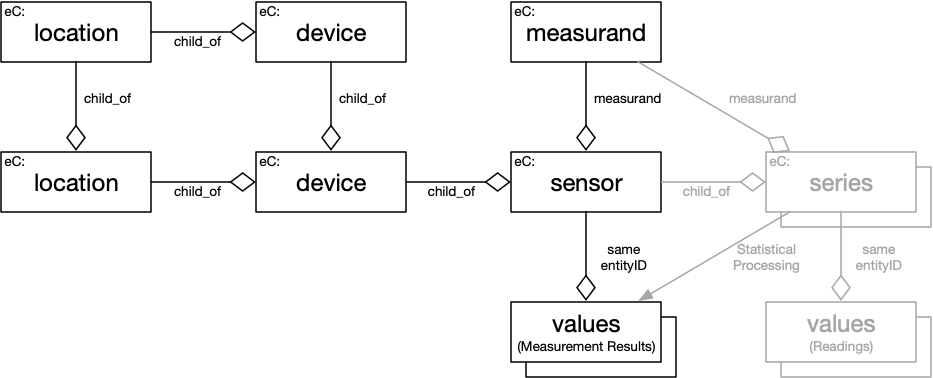
Each fragment has the following primary relationships:
* Each value fragment is associated with one series fragment by entity ID
* Each value fragment is associated with one sensor fragment by entity ID
* Each series fragment is associated with zero or more value fragments by entity ID
* Each series fragment is associated with zero or one measurand fragment by relation
* Each series fragment is associated with one sensor fragment by relation
* Each sensor fragment is associated with zero or more value fragments by entity ID
* Each sensor fragment is associated with zero or more series fragments by relation
* Each sensor fragment is associated with zero or one measurand fragment by relation
* Each sensor fragment is associated with zero or more device fragment by relation
* Each measurand fragment is associated with zero or more series fragments by relation
* Each measurand fragment is associated with zero or more sensor fragments by relation
* Each device fragment is associated with zero or more device fragments by relation
* Each device fragment is associated with zero or more location fragments by relation
* Each device fragment is associated with zero or more sensor fragments by relation
* Each location fragment is associated with zero or more device fragments by relation
* Each location fragment is associated with zero or more location fragments by relation
See [Section 3](#rel) for details on additional relationships.
### <a name="intro.used"></a>1.6 How are SNON fragments used?
When two entities want to exchange sensor data, fragments are constructed, packaged together as needed, and transported over protocols such as MQTT, Websockets, HTTP, etc.
There are three primary use cases:
1. Sensor definition publishing - A sensor device publishes series, sensor, measurand, device and location fragments that are used to create/update a sensor catalog.
2. Sensor value publishing - A sensor device publishes values for one or more series.
3. Sensor value subscription - A sensor device receives values for one or more series, and sets an actuator.
<hr>
## <a name="data"></a>2. SNON Data Model
### <a name="data.fragments"></a>2.1 SNON Fragments
SNON defines seven "fragments": JSON objects used to exchange data between entities within a sensor network.
* [value fragment](#data.value) - Represents one or more *measurements* for a given *measured quantity* by a given *measurement instrument*
* [series fragment](#data.series) - Represents one or more related value fragments for a given *measured quantity* by a given *measurement instrument*
* [sensor fragment](#data.sensor) - Represents a component of a *measurement instrument* that performs *measurements* of a given *measured quantity*
* [measurand fragment](#data.measurand) - Represents a *measured quantity*
* [device fragment](#data.device) - Represents a *measurement instrument*
* [location fragment](#data.location) - Represents a location of a *measurement instrument*
* [relationship fragment](#data.rel) - Represents a relationship between two SNON entities
SNON fragments may be transported using other protocols such as [CloudEvents](https://github.com/cloudevents/spec/blob/v1.0.1/spec.md). See [Section 7](#transports) for more details on how SNON works with transport protocols.
### <a name="data.packs"></a>2.2 SNON Packs
SNON defines a "pack": A JSON array containing one or more SNON fragments.
SNON pack may be signed and/or encrypted using the JOSE JWE and JWS standards, as described in [Section 6](#security).
<center>

<br>
Figure 2 - SNON Object Model
<br><br></center>
#### Example 2.2.1: An SNON pack with two fragments
[
{
"eID":"urn:uuid:cd9f930e-a3b4-423a-850b-3c81135f0f7e",
"eC": "series",
"eN": {"zh": "冷却水温度", "*": "Cooling Water Temperature"}
},
{
"eID": "urn:uuid:cd9f930e-a3b4-423a-850b-3c81135f0f7e",
"v": ["28.1"],
"vT": ["2014-08-20T14:32:57.126Z"]
}
]
#### Example 2.2.2: An encrypted SNON pack using JOSE JWE encryption
[
{
"encrypted_key": "YO03wcQVvap0_Z1i06zS9P9zy3FL8j1-3DeKpimAsgz4cM2Q4mHK7jdqLYaLVjHFf4jPT2PwV1Vm1DRPdT0H93qWO2fACX1Z5q0eGYaO15g91pd4HYXwTIfCkQL2uCGOzIvi7lbuiaV9kqCoAOkEeD-IPEmAXXAFPaY4UY4Jlw28KXdHj9JKVaLZhPnAwv6i59TOxOCAlrbhRSKXDzmzHXxK7hoo6N2dfxbQiTY7m7aYj_c-XwvcBf-x1i5vJ15BID4oUEZizvCT5EG1nZ3CF0xGfEc_8uQFa1lAY4rog3LqTtCYq2pvrEsCnpFfxRSwbh57gxy0T7ejnG_oSNL-dQ",
"iv":"G7qbtZKCry2IQvmL",
"protected":"eyJhbGciOiJSU0ExXzUiLCJlbmMiOiJBMTI4R0NNIn0",
"tag":"YFxioUzLdUfCMSJdm5eVjw",
"ciphertext":"H6HMYwGUY6y8vZeBT9w8D-nhu9irDT3qI7tWXElI2SR_AgaeQN-Im3AsTh4Wcf72imd466wspYoKRl-EptHNPfYHg2WxOOfVSC3iZwR7ovRHZ-3E_U9La4AY0_9fnKXDN_d0g8ssHhks6exEiJYWQfFyEs_V57wsIXEmelFXxbHBq7vkFptIxITYVvDOa_LsQ5eu5AnFXYRKdHE9Ih8E4qAs6b8KslZ3vVd06Kn0PApBmEOo56IF_0mgDMfv_RuMDfXrdnl83p5bffCX3qoyfxquLRT-fYFiNb5au9IaA1HOpKuJa-QkfcyWVz2u8ATtfrCS9TdYfDkgRHPCAzZEf0AUJejGhEIOT2l4Dr2tmK3_NDodqetYT9C298P2RiWqdx6p4doPMWOWb4iwm0kzcPnNqqu97OQyLofjHR4vJ2VsWibmMz6hTKnLooarpAjGylFaTO4KocAm0ybuMrQueldsk1nD7BYfzrrsIeWlVf5TYHyYbG7nJ4PgEVQV4PwoTVabrcRnJhrDNV5nC_mBYCKpdLnrSTlmiDn1-VtkrF7mdKR1NcRB9TWSCtO9Nj0ldLkalZy-tDXS4zrOoMz1Mm9_ol8Cw9Bih3agg4yFXppI5pxay_U8yOZ0oVYzIIP0DP0bVaLMv2WkjVDRJXIM8oupzgNM-k_ThTfwhkGq5NJSBsBvvRjl_gvYvfvc1fEIR7fcr_XIsqM5G4XbeniezeAWXi6olRLUV_wezJMa7U0eqAjGde4mAFRn3IjtUJvkbl-0ea8hbH7nqbsO3Mo"
}
]
### <a name="data.entity"></a>2.3 Common SNON Fields
All SNON Fragments may contain the following JSON fields:
| Field&nbsp;Name | Label | JSON&nbsp;Type | Description | Mandatory |
| ------------- | ------------- | ------------- | ------------- | --------- |
| Entity ID | eID | JSON String | Globally unique identifier of the entity.<br><br>Uniquely identifies the entity, allowing fragment receivers to determine which device the fragment contents or relationship applies to. Every fragment generator shall ensure that each entity ID is globally unique by using a technique such as random or MAC-based UUID generation as described in [RFC 4122](https://tools.ietf.org/html/rfc4122), a hash-based URN namespace such as urn-5, or a urn namespace that permits unique identification such as the [RFC 9039](https://datatracker.ietf.org/doc/html/rfc9039) "dev" namespace.<br><br>The value of this field shall be formatted as an [RFC 8141](https://tools.ietf.org/html/rfc8141) URN.<br><br><b>Example 2.3.1</b><pre>{<br> "eID": "urn:uuid:cd9f930e-a3b4-423a-850b-3c81135f0f7e"<br>}</pre> | Mandatory |
| Entity class | eC | JSON String | SNON Fragment type.<br><br>Identifies what the entity represents.<br><br>The value of this field shall be one of the following strings:<br><br>a) "value"<br>b) "series"<br>c) "sensor"<br>d) "measurand"<br>e) "device"<br>f) "location"<br>g) "relationship"<br><br>If this field is not present, the default value shall be "value".<br><br><b>Example 2.3.2</b><pre>{<br> "eC": "series"<br>}</pre> | Mandatory<br>(optional for value fragments) |
| Entity update time | eUT | JSON String | Time when the entity was updated.<br><br>Indicates when an entity was changed.<br><br>The value of this field shall contain a JSON Strings with the value of an [ISO 8601](https://www.iso.org/iso-8601-date-and-time-format.html) extended representation date/time format ("YYYY-MM-DDTHH:MM:SS.MMMZ").<br><br>In most sensor systems, non-value entities are immutable. However, if entities change over time, such as location, this field is required in order to provide eventually consistent state when processing fragments out-of-order, as it allows the time ranges when different versions of an entity to be in effect.<br><br><b>Example 2.3.3</b><pre>{<br> "eUT": "2014-08-20T14:32:57.126Z"<br>}</pre> | Optional<br>(Not permitted in value fragments) |
| Entity display name | eN | JSON Object | Descriptive Name of the entity.<br><br>Provides a set of human-readable names that describe the entity, allowing fragment receivers to list and identify the entity to end users.<br><br>The value of this field shall contain one or more JSON Strings, each with a name specifying the language tag as defined in [RFC 5646](https://tools.ietf.org/html/rfc5646), and a value containing a descriptive name of the entity in that language-region. <br><br>A name of "*" is used as a default language-region, as defined in [RFC 4647](https://tools.ietf.org/html/rfc4647).<br><br><b>Example 2.3.4</b><pre>{<br> "eN": {<br> "zh": "冷却水温度",<br> "en": "Cooling Water Temperature"<br> }<br>}</pre> | Optional<br>(Not permitted in value fragments) |
| Entity display type | eT | JSON Object | Descriptive Name of the type of the entity.<br><br>Provides a set of human-readable names that describe the entity type.<br><br>The value of this field shall contain one or more JSON Strings, each with a name specifying the language tag as defined in [RFC 5646](https://tools.ietf.org/html/rfc5646), and a value containing a descriptive name of the sensor in that language-region. <br><br>A name of "*" is used as a default language-region, as defined in [RFC 4647](https://tools.ietf.org/html/rfc4647).<br><br><b>Example 2.3.5:</b><pre>{<br> "eT": {<br> "zh": "温度传感器",<br> "en": "Temperature Sensor"<br> }<br>}</pre> | Optional<br>(Not permitted in value fragments) |
| Entity relationships | eR | JSON Object containing JSON Arrays of JSON Strings | Globally unique identifiers of related entities.<br><br>Identifies relationships between entities. Each relationship is a JSON object with the name specifying the type of relationship, and the value containing an array of URIs specifying the related entities. Relationships are described in more detail in [Section 3](#rel).<br><br>The value of each ID shall be formatted as an [RFC 8141](https://tools.ietf.org/html/rfc8141) URN.<br><br><b>Example 2.3.6</b><pre>{<br> "eR": {<br> "child_of": ["urn:uuid:cd9f930e-a3b4-423a-850b-3c81135f0f7e"]<br> }<br>}</pre> | Optional<br>(Not permitted in value fragments) |
| Extensions | ext | JSON Object | Contains user-defined fields extending a fragment.<br><br><b>Example 2.3.7</b><pre>{<br> "ext": {<br> "modbus": {<br> "unitID": "1",<br> "address": "7036",<br> "type": "IF32"<br> }<br> }<br>}</pre> | Optional |
### <a name="data.value"></a>2.4 Value SNON Fields
Value SNON fragments may also contain the following JSON fields:
| Field&nbsp;Name | Label | JSON&nbsp;Type | Description | Mandatory |
| ------------- | ------------- | ------------- | ------------- | --------- |
| Value time | vT | JSON Array of JSON Strings | Indication of one or more points in time or durations in time associated with measured values.<br><br>Provides an indication of when values were measured.<br><br>The value of this field shall contain one or more JSON Strings, with the contents of each string corresponding to the time a value was measured, in [ISO 8601](https://www.iso.org/iso-8601-date-and-time-format.html) extended representation date/time format ("YYYY-MM-DDTHH:MM:SS.MMMZ"), or time interval format (e.g. "YYYY-MM-DDTHH:MM:SS.MMMZ/PTxx.xxxS").<br><br>When multiple times are included in a value fragment, subsequent value times can be in time interval format (e.g. "YYYY-MM-DDTHH:MM:SS.MMMZ/PTxx.xxxS") or relative time interval format (e.g. "PTxx.xxxS"). All value array fields shall have the same number of entries, with the order consistent across fields.<br><br><b>Example 2.4.1</b><pre>{<br> "v": ["10", "11", "12"],<br> "vT": ["2014-08-20T14:32:56Z", "2014-08-20T14:32:57Z/PT1S", "PT1S"]<br>}</pre> | Mandatory |
| Value | v | JSON Array of JSON Strings | Indication of one or more values measured from the sensor.<br><br>Provides an indication of a measured value at a given point in time.<br><br>The value of this field shall contain one or more JSON Strings, with the contents of each string corresponding to the type of the sensor. All value array fields shall have the same number of entries, with the order consistent across fields.<br><br>If a min and max are provided, the value represents the average value over the acquisition period specified in the value time field.<br><br><b>Example 2.4.2</b><pre>{<br> "v": ["10"],<br> "vT": ["2014-08-20T14:32:56.125Z"]<br>}</pre> | Mandatory<br>Not required for immediate value updates |
| Value max | vMax | JSON Array of JSON Strings | Indication of one or more maximum values measured from the sensor.<br><br>Provides an indication of a maximum measured value during a given interval in time. Min/Max/Average values are typically used when sensor samples a value at a higher rate then is reported, and when the envelope contains important information.<br><br>The value of this field shall contain one or more JSON Strings, with the contents of each string corresponding to the type of the sensor. All value array fields shall have the same number of entries, with the order consistent across fields.<br><br><b>Example 2.4.3</b><pre>{<br> "v": ["10"],<br> "vMax": ["12"],<br> "vMin": ["8"],<br> "vT": ["2014-08-20T14:32:56.125Z"]<br>}</pre> | Optional |
| Value min | vMin | JSON Array of JSON Strings | Indication of one or more minimum values measured from the sensor.<br><br>Provides an indication of a minimum measured value during a given interval in time. Min/Max/Average values are typically used when sensor samples a value at a higher rate then is reported, and when the envelope contains important information.<br><br>The value of this field shall contain one or more JSON Strings, with the contents of each string corresponding to the type of the sensor. All value array fields shall have the same number of entries, with the order consistent across fields.<br><br><b>Example 2.4.4</b><pre>{<br> "v": ["10"],<br> "vMax": ["12"],<br> "vMin": ["8"],<br> "vT": ["2014-08-20T14:32:56.125Z"]<br>}</pre> | Optional |
| Value timeout | vTo | JSON Array of JSON Strings | Indication of the timeout associated with each value.<br><br>Provides a measure of how long a given value should be considered valid. If the specified time duration since the value time has been exceeded, the corresponding value shall no longer be considered valid.<br><br>When present, this field overrides a measure timeout field.<br><br>The value of this field shall contain one or more JSON Strings, with the contents of each string containing a numeric value measured in seconds.<br><br><b>Example 2.4.5</b><pre>{<br> "v": ["10"],<br> "vT": ["2014-08-20T14:32:56.125Z"],<br> "vTo": ["0.1"]<br>}</pre> | Optional |
| Value error | vE | JSON String | Indication that errors are present.<br><br>Provides an indication of errors associated with value or set of values.<br><br>The value of this field shall contain a string describing the error. The contents of the error string is sensor-dependent.<br><br><b>Example 2.4.6</b><pre>{<br> "v": ["10"],<br> "vT": ["2014-08-20T14:32:56.125Z"],<br> "vE": "Out of Calibration"<br>}</pre> | Optional |
Value fragments shall contain an "eID" field and may include an "eC" field set to "value".
#### Value Fragment Schema
"value_fragment": {
"type": "object",
"required": [
"eID",
"v",
"vT"
],
"properties": {
"eID": { "$ref": "#/definitions/type_id" },
"eC": { "type": "string",
"enum": [ "value" ] },
"v": { "$ref": "#/definitions/type_string_array" },
"vT": { "$ref": "#/definitions/type_iso8601_timeduration_array" },
"vMax": { "$ref": "#/definitions/type_string_array" },
"vMin": { "$ref": "#/definitions/type_string_array" },
"vTo": { "$ref": "#/definitions/type_numeric_string_array" },
"vE": { "type": "string" },
"ext": { "$ref": "#/definitions/type_extensions" }
},
"additionalProperties": false
}
#### SenML Interoperability (Draft)
Value fragments in [SenML (RFC 8428)](https://datatracker.ietf.org/doc/html/rfc8428) format are supported by using same value for the SNON entity ID and the SenML name. SenML records that depend on a base name cannot be processed out of order.
Recommendations for SNON and SenML integration:
* Prefer using resolved records that do not depend on SenML base fields, as these significantly complicate processing, especially when measurements are missing or received out of order.
* The SenML units "u" field and update time "ut" field can be omitted, as these are specified by the SNON measurand measure unit "meU" and measure timeout "meTo" fields.
* Avoid using the SenML "sum" field, as this should be stored in the value or as a separate series.
* The SenML "v", "vs", "vb", and "vd" fields are used as the measurement value.
* Additional calculations are required to resolve time field values when relative times are used.
A typical use case for SNON together with SenML is to enable discover and self-description of SenML measurements.
### <a name="data.series"></a>2.5 Series SNON Fields
Series SNON fragments may also contain the following measure fields that will be used unless overridden by a measurand:
* Measure span low ("meSL")
* Measure span high ("meSH")
* Measure display low ("meDL")
* Measure display high ("meDH")
* Measure display unit ("meDU")
* Measure update rate ("meUR")
* Measure timeout ("meTo")
* Measure resolution ("meR")
* Measure accuracy ("meAc")
Measurand fields are described in [Section 2.7](#data.measurand).
#### Series Fragment Schema
"series_fragment": {
"type": "object",
"required": [
"eID",
"eC"
],
"properties": {
"eID": { "$ref": "#/definitions/type_id" },
"eC": { "type": "string",
"enum": [ "series" ] },
"eUT": { "$ref": "#/definitions/type_iso8601_time" },
"eT": { "$ref": "#/definitions/type_intl_name" },
"eN": { "$ref": "#/definitions/type_intl_name" },
"eR": { "$ref": "#/definitions/type_relations" },
"meSL": { "$ref": "#/definitions/type_numeric_string" },
"meSH": { "$ref": "#/definitions/type_numeric_string" },
"meDL": { "$ref": "#/definitions/type_numeric_string" },
"meDH": { "$ref": "#/definitions/type_numeric_string" },
"meDU": { "$ref": "#/definitions/type_intl_name" },
"meUR": { "$ref": "#/definitions/type_numeric_string" },
"meTo": { "$ref": "#/definitions/type_numeric_string" },
"meR": { "$ref": "#/definitions/type_numeric_string" },
"meAc": { "$ref": "#/definitions/type_numeric_string" },
"ext": { "$ref": "#/definitions/type_extensions" }
},
"additionalProperties": false
}
### <a name="data.sensor"></a>2.6 Sensor SNON Fields
Sensor SNON Fragments may also contain the following JSON fields:
| Field&nbsp;Name | Label | JSON&nbsp;Type | Description | Mandatory |
| ------------- | ------------- | ------------- | ------------- | --------- |
| Sensor tag | sT | JSON String | Identification tag for the entity.<br><br>The value of this field shall be a string containing the P&ID letters and loop number as defined in [ANSI/ISA-S5.1](https://www.isa.org/isa5-1/), RDS tag as defined in [ISO/IEC 81346](https://www.iso.org/standard/82229.html), or contain a user-defined tag values.<br><br><b>Example 2.6.1</b><pre>{<br> "sT": "TT1123"<br>}</pre> | Optional |
#### Sensor Fragment Schema
"sensor_fragment": {
"type": "object",
"required": [
"eID",
"eC"
],
"properties": {
"eID": { "$ref": "#/definitions/type_id" },
"eC": { "type": "string",
"enum": [ "sensor" ] },
"eUT": { "$ref": "#/definitions/type_iso8601_time" },
"eT": { "$ref": "#/definitions/type_intl_name" },
"eN": { "$ref": "#/definitions/type_intl_name" },
"eR": { "$ref": "#/definitions/type_relations" },
"sT": { "type": "string" },
"ext": { "$ref": "#/definitions/type_extensions" }
},
"additionalProperties": false
}
### <a name="data.measurand"></a>2.7 Measurand SNON Fields
Measurand SNON fragments may also contain the following JSON fields:
| Field&nbsp;Name | Label | JSON&nbsp;Type | Description | Mandatory |
| ------------- | ------------- | ------------- | ------------- | --------- |
| Measure unit | meU | JSON String | Unit indicator for the value measured by the sensor.<br><br>Identifies what physical or calculated quantity is being measured.<br><br>The value of this field shall be formatted as either:<br>a) an [ISO 80000-1:2009](https://www.iso.org/standard/30669.html) special symbol (or [SI unit symbol](http://www.bipm.org/en/si/si_brochure/)),<br> b) a combination of symbols for units, as defined in 7.2.2 of [ISO 80000-1:2009](https://www.iso.org/standard/30669.html),<br>c) a SenML unit as defined in [RFC 8428](https://datatracker.ietf.org/doc/html/rfc8428) or [RFC 8798](https://datatracker.ietf.org/doc/html/rfc8798),<br>d) an empty string, representing a unitless value, or,<br>e) a custom (non-SI) value.<br><br>If this field is not present, the default value shall be an empty string.<br><br>NOTE: While SI prefix conversion may be performed for display (e.g. 27.8 m/s -> 100 km/h), SNON measureUnit fields should always specify units without metric prefixes.<br><br><b>Example 2.7.1</b><pre>{<br> "meU": "m/s"<br>}</pre> | Optional |
| Measure type | meT | JSON String | Data type indicator for the value measured by the sensor.<br><br>Identifies what data type is stored in the value associated with a measurement.<br><br>The value of this field shall be contain one of the following:<br>a) "enumeration" &ndash; The sensor value shall contain a string representation of an integer, which corresponds to a string specified in the measure label field.<br>b) "numeric" &ndash; The sensor value shall contain a string representation of a number,<br>c) "string" &ndash; The sensor value shall consist of a UTF-8 string value,<br>d) "url" &ndash; The sensor value shall contain a string representation of a URL (including data URIs as defined in [RFC 2397](https://tools.ietf.org/html/rfc2397)),<br>e) "iso8601" &ndash; The sensor value shall contain a string representation of an [ISO 8601](https://www.iso.org/iso-8601-date-and-time-format.html) time or duration, or, <br>f) "ordinal" &ndash; The sensor value shall contain a string representation of a number which refers to a position or rank.<br><br>If this field is not present, the default value shall be "numeric".<br><br><b>Example 2.7.2</b><pre>{<br> "meT": "numeric"<br>}</pre> | Optional |
| Measure acquire | meAq | JSON String | Data Acquisition indicator for the value measured by the sensor.<br><br>Identifies what method is used by the sensor to acquire a value.<br><br>The value of this field shall be contain one of the following:<br><br>a) "sample" &ndash; The value represents a measurement made at the start of value time.<br>b) "count" &ndash; The value represents an increasing count, measured the start of value time.<br>c) "triggered" &ndash; The value represents a measurement, captured at the end of the value time.<br>d) "summary" &ndash; the value represents a summarization of measurements that occurred during the value time range.<br>e) "derived" &ndash; The value represents calculations of measurements, valid for the start of value time.<br><br>If this field is not present, the default value shall be "sample".<br><br><b>Example 2.7.3</b><pre>{<br> "meAq": "sample"<br>}</pre> | Optional |
| Measure unit prefix | meUP | JSON Object | Descriptive Name of the prefix to be displayed before the measured value.<br><br>Provides a set of human-readable prefixes that come before the value measured by the sensor, allowing fragment receivers to display sensor measurements to end users.<br><br>The value of this field shall contain one or more JSON Strings, each with a name specifying the language tag as defined in [RFC 5646](https://tools.ietf.org/html/rfc5646), and a value containing a prefix in that language-region, to be displayed before the value of the measurement. <br><br>A name of "*" is used as a default language-region, as defined in [RFC 4647](https://tools.ietf.org/html/rfc4647).<br><br><b>Example 2.7.4</b><pre>{<br> "meUP": {<br> "zh": "大约",<br> "&#42;": "≈"<br> }<br>}</pre> | Optional |
| Measure unit prefix extended | meUPx | JSON Object | Extended descriptive Name of the prefix to be displayed before the measured value.<br><br>Provides a long-form set of human-readable prefixes that come before the value measured by the sensor, allowing fragment receivers to display sensor measurements to end users.<br><br>The value of this field shall contain one or more JSON Strings, each with a name specifying the language tag as defined in [RFC 5646](https://tools.ietf.org/html/rfc5646), and a value containing a long-form prefix in that language-region, to be displayed before the value of the measurement. <br><br>A name of "*" is used as a default language-region, as defined in [RFC 4647](https://tools.ietf.org/html/rfc4647).<br><br><b>Example 2.7.5</b><pre>{<br> "meUPx": {<br> "zh": "大约",<br> "&#42;": "Approx."<br> }<br>}</pre> | Optional |
| Measure unit suffix | meUS | JSON Object | Descriptive Name of the suffix to be displayed after the measured value.<br><br>Provides a set of human-readable suffixes that come after the value measured by the sensor, allowing fragment receivers to display sensor measurements to end users.<br><br>The value of this field shall contain one or more JSON Strings, each with a name specifying the language tag as defined in [RFC 5646](https://tools.ietf.org/html/rfc5646), and a value containing a suffix in that language-region, to be displayed after the value of the measurement. <br><br>A name of "*" is used as a default language-region, as defined in [RFC 4647](https://tools.ietf.org/html/rfc4647).<br><br><b>Example 2.7.6</b><pre>{<br> "meUS": {<br> "zh": "华氏度",<br> "en-us": "℉",<br> "&#42;": "℃"<br> }<br>}</pre> | Optional |
| Measure unit suffix extended | meUSx | JSON Object | Extended descriptive Name of the suffix to be displayed after the measured value.<br><br>Provides a long-form set of human-readable suffixes that come after the value measured by the sensor, allowing fragment receivers to display sensor measurements to end users.<br><br>The value of this field shall contain one or more JSON Strings, each with a name specifying the language tag as defined in [RFC 5646](https://tools.ietf.org/html/rfc5646), and a value containing a long-form suffix in that language-region, to be displayed after the value of the measurement. <br><br>A name of "*" is used as a default language-region, as defined in [RFC 4647](https://tools.ietf.org/html/rfc4647).<br><br><b>Example 2.7.7</b><pre>{<br> "meUSx": {<br> "zh": "华氏度",<br> "en-us": "degrees Fahrenheit",<br> "&#42;": "degrees Celsius"<br> }<br>}</pre> | Optional |
| Measure label | meL | JSON Object of JSON Objects | Descriptive Name of enumeration values.<br><br>Provides a set of human-readable values corresponding to enumerated values of a sensor of type "enumerated", allowing fragment receivers to display sensor measurements to end users.<br><br>The value of this field shall contain a JSON Object, with each object contained being a JSON Object containing one or more JSON Strings, each with a name specifying the language tag as defined in [RFC 5646](https://tools.ietf.org/html/rfc5646), and a value containing a long-form suffix in that language-region, to be displayed before the value of the measurement. <br><br>A name of "*" is used as a default language-region, as defined in [RFC 4647](https://tools.ietf.org/html/rfc4647).<br><br><b>Example 2.7.8</b><pre>{<br> "meL": {<br> "0":{<br> "zh": "打开阀门",<br> "en-us": "Open Valve"<br> },<br> "1":{<br> "zh": "关闭阀门",<br> "en-us": "Closed Valve"<br> }<br> }<br>}</pre> | Optional |
| Measure span low | meSL | JSON String | Indication of the minimum operating value.<br><br>Provides an indication of the lowest operating value where the sensor is rated to be within its normal error band.<br><br>The value of this field shall match the value specified in the sensor's measureType field.<br><br><b>Example 2.7.9</b><pre>{<br> "meSL":"-100"<br>}</pre> | Optional |
| Measure span high | meSH | JSON String | Indication of the maximum operating value.<br><br>Provides an indication of the highest operating value where the sensor is rated to be within its normal error band.<br><br>The value of this field shall match the value specified in the sensor's measureType field.<br><br><b>Example 2.7.10</b><pre>{<br> "meSH":"100"<br>}</pre> | Optional |
| Measure display low | meDL | JSON String | Indication of the minimum value for display purposes.<br><br>Provides an indication of the lowest value the sensor is expected to return during normal operation. This permits a fragment receiver to size charts and other display outputs appropriately.<br><br>The value of this field shall match the value specified in the sensor's "measure type" field.<br><br><b>Example 2.7.11</b><pre>{<br> "meDL":"0"<br>}</pre> | Optional |
| Measure display high | meDH | JSON String | Indication of the maximum value for display purposes.<br><br>Provides an indication of the highest value the sensor is expected to return during normal operation. This permits a fragment receiver to size charts and other display outputs appropriately.<br><br>The value of this field shall match the value specified in the sensor's "measure type" field.<br><br><b>Example 2.7.12</b><pre>{<br> "meDH":"50"<br>}</pre> | Optional |
| Measure display unit | meDU | JSON Object | Indication of the unit used for display purposes.<br><br>Provides an indication of what unit should be used for display purposes. This permits a specific directive for how a fragment receiver should convert from SI base units.<br><br>The value of this field shall contain one or more JSON Strings, each with a name specifying the language tag as defined in [RFC 5646](https://tools.ietf.org/html/rfc5646), and a value containing either:<br><br>a) a combination of [ISO 80000-1:2009](https://www.iso.org/standard/30669.html) special symbol (or [SI unit symbol](http://www.bipm.org/en/si/si_brochure/)), optionally including SI prefixes,<br> b) an SI prefix, or,<br>c) a custom (non-SI) value.<br><br>A name of "*" is used as a default language-region, as defined in [RFC 4647](https://tools.ietf.org/html/rfc4647).<br><br><b>Example 2.7.13</b><pre>{<br> "meU": "m/s",<br> "meDU": {<br> "en-us":"mile/hr",<br> "&#42;":"km/hr"<br> }<br>}</pre> | Optional |
| Measure update rate | meUR | JSON String | Indication of the maximum rate at which a sensor value will be updated.<br><br>Provides an indication of the shortest interval that a sensor value can be polled to obtain a new reading. This permits a fragment sender to determine the rate at which values should be generated.<br><br>The value of this field shall be a string containing a numeric value measured in seconds.<br><br><b>Example 2.7.14</b><pre>{<br> "meUR":"0.1"<br>}</pre> | Optional |
| Measure timeout | meTo | JSON String | Indication of the timeout associated with each measurement.<br><br>If the specified time duration since the value time has been exceeded, the corresponding value shall no longer be considered valid.<br><br>The value of this field shall be a string containing a numeric value measured in seconds.<br><br><b>Example 2.7.15</b><pre>{<br> "meTo":"10"<br>}</pre> | Optional |
| Measure resolution | meR | JSON String | Indication of the smallest detectable change measurable by the sensor.<br><br>Provides an indication of the smallest detectable change of the value being measured that will result in a different value reading. This permits a fragment sender to determine significant figures.<br><br>The value of this field shall be a string containing a numeric value corresponding to the units defined for the sensor.<br><br><b>Example 2.7.16</b><pre>{<br> "meR":"0.1"<br>}</pre> | Optional<br><br>Only valid for measure type "numeric" |
| Measure accuracy | meAc | JSON String | Indication of range of possible measurement error.<br><br>Provides an indication of the largest difference (+/-) expected to exist between the measured value and the actual value. This permits a fragment sender to determine significant figures.<br><br>The value of this field shall be a string containing a positive numeric value corresponding to the units defined for the sensor. Accuracy shall be +/- the specified value.<br><br><b>Example 2.7.17</b><pre>{<br> "meAc":"0.1"<br>}</pre> | Optional<br><br>Only valid for measure type "numeric" |
#### Measurand Fragment Schema
"measurand_fragment": {
"type": "object",
"required": [
"eID",
"eC"
],
"properties": {
"eID": { "$ref": "#/definitions/type_id" },
"eC": { "type": "string",
"enum": [ "measurand" ] },
"eUT": { "$ref": "#/definitions/type_iso8601_time" },
"eT": { "$ref": "#/definitions/type_intl_name" },
"eN": { "$ref": "#/definitions/type_intl_name" },
"eR": { "$ref": "#/definitions/type_relations" },
"meU": { "type": "string" },
"meT": { "type": "string",
"enum": [ "enumeration", "numeric", "string", "url", "iso8601", "ordinal"] },
"meAq": { "type": "string",
"enum": [ "sample", "count", "triggered", "summary", "derived"] },
"meUP": { "$ref": "#/definitions/type_intl_name" },
"meUS": { "$ref": "#/definitions/type_intl_name" },
"meUPx": { "$ref": "#/definitions/type_intl_name" },
"meUSx": { "$ref": "#/definitions/type_intl_name" },
"meL": { "$ref": "#/definitions/type_intl_enum" },
"meSL": { "$ref": "#/definitions/type_numeric_string" },
"meSH": { "$ref": "#/definitions/type_numeric_string" },
"meDL": { "$ref": "#/definitions/type_numeric_string" },
"meDH": { "$ref": "#/definitions/type_numeric_string" },
"meDU": { "$ref": "#/definitions/type_intl_name" },
"meUR": { "$ref": "#/definitions/type_numeric_string" },
"meTo": { "$ref": "#/definitions/type_numeric_string" },
"meR": { "$ref": "#/definitions/type_numeric_string" },
"meAc": { "$ref": "#/definitions/type_numeric_string" },
"ext": { "$ref": "#/definitions/type_extensions" }
},
"additionalProperties": false
}
### <a name="data.device"></a>2.8 Device SNON Fields
Device SNON Fragments may also contain the following JSON fields:
| Field&nbsp;Name | Label | JSON&nbsp;Type | Description | Mandatory |
| ------------- | ------------- | ------------- | ------------- | --------- |
| Device tag | dT | JSON String | Identification tag for the device.<br><br>The value of this field shall be a string containing RDS tag as defined in [ISO/IEC 81346](https://www.iso.org/standard/82229.html) or contain a user-defined tag values.<br><br><b>Example 2.8.1</b><pre>{<br> "dT": "=K1=B1"<br>}</pre> | Optional |
#### Device Fragment Schema
"device_fragment": {
"type": "object",
"required": [
"eID",
"eC"
],
"properties": {
"eID": { "$ref": "#/definitions/type_id" },
"eC": { "type": "string",
"enum": [ "device" ] },
"eUT": { "$ref": "#/definitions/type_iso8601_time" },
"eT": { "$ref": "#/definitions/type_intl_name" },
"eN": { "$ref": "#/definitions/type_intl_name" },
"eR": { "$ref": "#/definitions/type_relations" },
"dT": { "type": "string" },
"ext": { "$ref": "#/definitions/type_extensions" }
},
"additionalProperties": false
}
### <a name="data.location"></a>2.9 Location SNON Fields
Location SNON Fragments may also contain the following JSON fields:
| Field&nbsp;Name | Label | JSON&nbsp;Type | Description | Mandatory |
| ------------- | ------------- | ------------- | ------------- | --------- |
| Location tag | lT | JSON String | Identification tag for the location.<br><br>The value of this field shall be a string containing RDS tag as defined in [ISO/IEC 81346](https://www.iso.org/standard/82229.html) or contain a user-defined tag values.<br><br><b>Example 2.9.1</b><pre>{<br> "lT": "++2.BAA2"<br>}</pre> | Optional |
#### Location Fragment Schema
"location_fragment": {
"type": "object",
"required": [
"eID",
"eC"
],
"properties": {
"eID": { "$ref": "#/definitions/type_id" },
"eC": { "type": "string",
"enum": [ "location" ] },
"eUT": { "$ref": "#/definitions/type_iso8601_time" },
"eT": { "$ref": "#/definitions/type_intl_name" },
"eN": { "$ref": "#/definitions/type_intl_name" },
"eR": { "$ref": "#/definitions/type_relations" },
"lT": { "type": "string" },
"ext": { "$ref": "#/definitions/type_extensions" }
},
"additionalProperties": false
}
### <a name="data.rel"></a>2.10 Relationship SNON Fields
Relationship SNON Fragments may also contain the following JSON fields:
| Field&nbsp;Name | Label | JSON&nbsp;Type | Description | Mandatory |
| ------------- | ------------- | ------------- | ------------- | --------- |
| Relationship source | rS | JSON String | Indicates the source of the relationship.<br><br>The value of this field shall be an entity ID.<br><br><b>Example 2.10.1</b><pre>{<br> "rS": "urn:urn-5:3b905aa9c63d454d9e8ac30084e7271bc662e88e68e811d9cfe3c73bf62eb9f6"<br>}</pre> | Mandatory |
| Relationship destination | rD | JSON String | Indicates the destination of the relationship.<br><br>The value of this field shall be an entity ID.<br><br><b>Example 2.10.2</b><pre>{<br> "rD": "urn:uuid:731f0515-078d-48cf-a136-99e57ad21b8b"<br>}</pre> | Mandatory |
| Relationship type | rT | JSON String | Indicates the type of relationship.<br><br>The value of this field shall be an string indicating the relationship type (See [section 3](#rel)).<br><br><b>Example 2.10.3</b><pre>{<br> "rT": "parent_of"<br>}</pre> | Mandatory |
Relationship objects can be used to express any relationship that can be specified using an entity relationship field, but are seperate from the entities being linked.
#### Relationship Fragment Schema
"relationship_fragment": {
"type": "object",
"required": [
"eID",
"eC",
"rS",
"rD",
"rT"
],
"properties": {
"eID": { "$ref": "#/definitions/type_id" },
"eC": { "type": "string",
"enum": [ "relationship" ] },
"eUT": { "$ref": "#/definitions/type_iso8601_time" },
"eT": { "$ref": "#/definitions/type_intl_name" },
"eN": { "$ref": "#/definitions/type_intl_name" },
"eR": { "$ref": "#/definitions/type_relations" },
"rS": { "$ref": "#/definitions/type_id" },
"rD": { "$ref": "#/definitions/type_id" },
"rT": { "type": "string" },
"ext": { "$ref": "#/definitions/type_extensions" }
},
"additionalProperties": false
}
<hr>
## 3. <a name="rel"></a>SNON Entity Relationships
### 3.1 <a name="rel.model"></a>Relationship Model
The relationship model between entities is defined according to the following model:
<center>

<br>
Figure 3 - SNON Relationship Model
<br><br></center>
Relationships are expressed in relationship fragments or as the contents of the entity relationship field within a fragment. When using a entity relationship field within a fragment, the relationship source is the entity ID of the fragment the entity relationship field is contained in.
#### Example 3.1.1: Equivalent Relationships in SNON fragments
[
{
"eID":"urn:uuid:13818320-a6f9-4caa-8660-d39ab5bdb6aa",
"eC": "device",
"eR": {
"child_of": [ "urn:uuid:ca343afd-bc22-4188-b58c-7ab624a800cd" ]
}
}
]
[
{
"eID":"urn:uuid:c0f44d6e-ad62-4f4d-9518-6c778fb1522d",
"eC": "relationship",
"rS": "urn:uuid:13818320-a6f9-4caa-8660-d39ab5bdb6aa",
"rD": "urn:uuid:ca343afd-bc22-4188-b58c-7ab624a800cd",
"rT": "child_of"
}
]
Relationship fragments enable more expressive relationships compared with using relationship fields within existing fragments:
1. Relationships can be created after the relationship source has been created
1. Relationships can be created by different system components then the entities being linked
1. Relationships can be created where the relationship source or relationship destination is another relationship fragment, allowing relationships with relationships
### <a name="rel.general"></a>3.2 General Relationships
The following general relationships are defined as part of SNON:
| Relationship&nbsp;Type | Description |
| ----------------- | ------------- |
| "child_of" | Defines hierarchies between entities.<br><br>Figure 4 shows how child_of relationships can be used to associate series with sensors, and sensors with devices:<center><br>Figure 4 - SNON "child_of" Relationships between series, sensors and devices<br><br></center><br><br>Figure 5 shows how child_of relationships can be used to associate devices with larger devices:<center><br>Figure 5 - SNON "child_of" Relationships between devices<br><br></center><br><br>Figure 6 shows how child_of relationships can be used to associate devices with locations, and locations with locations:<center><br>Figure 6 - SNON "child_of" Relationships between devices and locations<br><br></center> |
| "measurand" | Indicates what measured quantity a given sensor is measuring.<br><br>Figure 7 shows how measurand relationships can be used to indicate which measured quantity is being measured by a given sensor:<center><br>Figure 7 - SNON "measurand" Relationships for series and sensors<br><br></center> |
| "powered_by" | Defines power supply relationships between entities.Figure 8 shows how powered_by relationships can be used to indicate which devices are supplied power by which devices:<center><br>Figure 8 - SNON "powered_by" Relationships between devices<br><br></center> |
| "timesync_by" | Defines time synchronization relationships between entities.<br><br>Figure 9 shows how timesync_by relationships can be used to indicate which devices are supplied time synchronzation by which devices:<center><br>Figure 9 - SNON "timesync_by" Relationships between devices<br><br></center> |
| "connected_to" | Defines network connectivity relationships between entities.<br><br>Figure 10 shows how connected_to relationships can be used to indicate which devices are connected to which devices:<center><br>Figure 10 - SNON "connected_to" Relationships between devices<br><br></center> |
| "located_at" | Defines the location of a given device or sensor.<br><br>Figure 11 shows how located_at relationships can be used to indicate a series that indicate the location of a device:<center><br>Figure 11 - SNON "located_at" Relationships for devices<br><br></center> |
| "measured_from" | Defines that devices or relationships a given sensor is measuring.<br><br>Figure 12 shows how measured_from relationships can be used to indicate that which sensors measure which devices or relationships:<center><br>Figure 12 - SNON "measured_from" Relationships between devices<br><br></center> |
### <a name="rel.series"></a>3.3 Related Series Relationships
The following series to series relationships are defined as part of SNON:
| Relationship&nbsp;Type | Description |
| ----------------- | ------------- |
| "health" | Indicates sensor health. Each "health" relationship indicates that the health of a specific series is indicated by a second series.<br><br>Figure 13 shows an example of a "health" relationship:<center><br>Figure 13 - SNON "health" Relationships<br><br></center> |
| "setpoint" | Indicates sensor setpoint. Each "setpoint" relationship indicates that the desired value/range of a specific series is indicated by a second series.<br><br>Figure 14 shows an example of a "setpoint" relationship:<center><br>Figure 14 - SNON "setpoint" Relationships<br><br></center> |
| "alarms" | Indicates sensor alarms. Each "alarms" relationship indicates that the alarms threshold value/range of a specific series is indicated by a second series.<br><br>Figure 15 shows an example of two "alarms" relationships:<center><br>Figure 15 - SNON "alarms" Relationships<br><br></center> |
| "alarm_inhibit" | Indicates that sensor alarms are to be inhibit. Each "alarm_inhibit" relationship indicates that any alarms for a specific series should be inhibited as indicated by a second series.<br><br>Figure 16 shows an example of an "alarm_inhibit" relationship:<center><br>Figure 16 - SNON "alarm_inhibit" Relationships<br><br></center> |
| "indeterminate" | Indicates sensor indeterminacy. Each "indeterminate" relationship indicates that the indeterminacy of a specific series is indicated by a second series.<br><br>Figure 17 shows an example of an "indeterminate" relationship:<center><br>Figure 17 - SNON "indeterminate" Relationships<br><br></center> |
| "flag" | Indicates unreliable sensor measurements that should not be included in aggregated values/statistical analysis. Each "flag" relationship indicates that the flag status of a specific series is indicated by a second series.<br><br>Figure 18 shows an example of an "flag" relationship:<center><br>Figure 18 - SNON "flag" Relationships<br><br></center> |
### <a name="rel.custom"></a>3.4 Custom Relationships
Custom relationships can be defined as part of an SNON implementation. For example, a custom "interrupts" relationship can associate a device with a relationship between two other devices:
| Relationship&nbsp;Type | Description |
| ----------------- | ------------- |
| "interrupts" | This relationship indicates that a "powered_by" relationship is conditional.<br><br>Figure 19 shows how interrupts relationships can be used to indicate that power supplied to a device can be interrupted by a second device:<center><br>Figure 19 - SNON "interrupts" Relationships between devices<br><br></center> |
<hr>
## <a name="examples"></a>4. SNON Examples
#### Example 4.1: A value fragment representing a single measured value:
[
{
"eID": "urn:uuid:e129c1d6-0ac9-474a-948e-813ff3dc4e31",
"v" : ["29.3"],
"vT" : ["2014-08-20T14:32:46.125Z"]
}
]
#### Example 4.2: Compact form of Example 4.1:
[{"eID":"urn:uuid:1635a44f-b770-4418-8f05-e721823e8e41","v":["29.3"],"vT":["2014-08-20T14:32:56.125Z"]}]
#### Example 4.3: A value fragment representing two values, measured at different times:
[
{
"eID": "urn:uuid:e129c1d6-0ac9-474a-948e-813ff3dc4e31",
"v" : ["29.3", "30.3"],
"vT" : ["2014-08-20T14:32:56.125Z", "2014-08-20T14:33:06.125Z"]
}
]
#### Example 4.4: A value fragment representing two values, with the second time expressed as a duration since the first time:
[
{
"eID": "urn:uuid:e129c1d6-0ac9-474a-948e-813ff3dc4e31",
"v" : ["29.3", "30.3"],
"vT" : ["2014-08-20T14:32:56.125Z", "PT10S"]
}
]
#### Example 4.5: A value fragment representing a value with an associated duration, rather than a point in time:
[
{
"eID": "urn:uuid:e129c1d6-0ac9-474a-948e-813ff3dc4e31",
"v" : ["29.3"],
"vT" : ["2014-08-20T14:32:56.125Z/PT10S"]
}
]
#### Example 4.6: A value fragment representing a value with minimum and maximum:
[
{
"eID": "urn:uuid:e129c1d6-0ac9-474a-948e-813ff3dc4e31",
"v" : ["29.3"],
"vMin" : ["28.1"],
"vMax" : ["33.2"],
"vT" : ["2014-08-20T14:32:56.125Z"]
}
]
#### Example 4.7: An SNON pack containing two value fragments, each for a different sensor:
[
{
"eID": "urn:uuid:e129c1d6-0ac9-474a-948e-813ff3dc4e31",
"v" : ["29.3"],
"vT" : ["2014-08-20T14:32:56.125Z"]
},
{
"eID": "urn:uuid:322ea74e-d914-44be-a95f-bb97b60b140b",
"v" : ["-102.2"],
"vT" : ["2014-08-20T14:32:56.125Z"]
}
]
#### Example 4.8: A series fragment associated with one or more value fragments, and linking them to a device and a measurand:
[
{
"eID": "urn:uuid:e129c1d6-0ac9-474a-948e-813ff3dc4e31",
"eC": "series",
"eN": { "*": "L1-E Voltage" },
"eR": {
"child_of": [ "urn:uuid:188b39c5-0b90-4850-b3cd-38f52558ca6f" ],
"measurand": [ "urn:uuid:866f4a0d-62cc-4324-bff1-b682a806df81" ]
}
}
]
#### Example 4.9: A measurand fragment representing the value quantity of the series in Example 4.8:
[
{
"eID": "urn:uuid:866f4a0d-62cc-4324-bff1-b682a806df81",
"eC": "measurand",
"eN": { "*": "120 VAC Nominal Voltage" },
"meU": "V",
"meT": "numeric",
"meAq": "sample",
"meDU": { "*": "v" },
"meDL": "110",
"meDH": "130",
"meUR": "2",
"meTo": "5"
}
]
#### Example 4.10: A sensor fragment associated with the device in Example 4.11:
[
{
"eID": "urn:uuid:188b39c5-0b90-4850-b3cd-38f52558ca6f",
"eC": "sensor",
"eN": { "*": "3 Phase Voltage" },
"eR": {
"child_of": [ "urn:uuid:a8c148df-00a1-40db-a833-7e1f53bc9ba0" ]
}
}
]
#### Example 4.11: A device fragment associated with the location in Example 4.12:
[
{
"eID": "urn:uuid:a8c148df-00a1-40db-a833-7e1f53bc9ba0",
"eC": "device",
"eN": { "*": "Power Meter" },
"eR": {
"child_of": [ "urn:uuid:e66dad18-8914-4126-39f8-1b786451edcf" ]
}
}
]
#### Example 4.12: A location fragment:
[
{
"eID": "urn:uuid:e66dad18-8914-4126-39f8-1b786451edcf",
"eC": "location",
"eN": { "*": "L113" }
}
]
<hr>
## <a name="schema"></a>5. SNON Schema
SNON fragments can be validated using following schema:
https://www.snon.org/v4/snon-schema.json
The following constraints are not validated by this schema, and shall be validated by the SNON receiver:
* Equal number of array items in value time, value, value max, value min and value timeout
* First item in value time shall be an ISO 8601 time (subsequent items may be an ISO 8601 duration)
* If there is a value time, at least one of value shall be present
* Contents of value, value max and value min shall correspond to resolved measure type
* Validity of SNON fragments contained within a JWS "payload" or JWE "ciphertext" field
* Ensuring that there is zero or one "measurand" relationship between a series and a measurand
* Ensuring that there is zero or one "measurand" relationship between a sensor and a measurand
* Ensuring that there is at least one "measurand" relationship between related series and sensors and a measurand
* Ensuring that "child_of" relationships in series fragments are only permitted with one sensor entity
<hr>
## <a name="security"></a>6. SNON Security
### <a name="security.encryption"></a>6.1 Encryption and Signing
Sensor data often must be encrypted to protect confidentiality, and signed to protect integrity and demonstrate the authenticity of the source of the data. SNON specifies the use of JSON Object Signing and Encryption (JOSE) as described in [RFC 7516](https://tools.ietf.org/html/rfc7516) and [RFC 7515](https://tools.ietf.org/html/rfc7515), although other encryption and signing standards may also be used.
An SNON collection shall be used as the plaintext, and JWE or JWS JSON Serialization shall be used for the encrypted or signed representation, as shown in the below example:
#### Example 6.1.1: A collection of SNON fragments to be protected:
[{"eID":"urn:uuid:fa164ee2-f1b7-43ee-8202-e61bc005db2b","v":["1"],"vT":["2017-11-29T03:32:03.752Z"]},{"eID":"urn:uuid:c4c0b0b6-f1c5-4695-9370-d925f8370c07","v":["0"],"vT":["2017-11-29T03:32:03.752Z"]},{"eID":"urn:uuid:d90526a1-4e62-493e-870c-6216216a03c8","v":["0"],"vT":["2017-11-29T03:32:03.752Z"]},{"eID":"urn:uuid:12b976ea-4867-42b1-bcc6-f6b1d5e938e7","v":["0"],"vT":["2017-11-29T03:32:03.752Z"]}]
#### Example 6.1.2: JWE representation when encrypted using RSA v1.5, according to [RFC 7520](https://tools.ietf.org/html/rfc7520#section-5.1):
[{"tag":"5DlAaLHKrg5JBCh604TtfQ","protected":"eyJhbGciOiJSU0ExXzUiLCJlbmMiOiJBMTI4R0NNIn0","iv":"QIuWxaOOwgIfw6oo","ciphertext":"fwk4KeCiC6rItJ_TD5kn7ymRn7eX-Ckqi0k3N18sEsksF39f2KBezt609IeZQuIqxFBheeLWucwuWa-tpYiWv-zDVUkQ-AhDNwdzo1tPevLOiUytU2NkCjK0uX6yazdaBHxVXFUbwa1HDQ_9-8H_wbpF1pPMrs5kBXt2cHUBdjpTopSfn0Q_rD8iHgz0s7eyMjWjSGqM5Fhg7T79qMwvRtqlyWIuqHVR40U2Gmhk4gy9VOXomq_P7qHeYB507zlAAxggsbYSJvwq6biluilqW5lPbDCR9MSsWjYFggSPr_aGDw6VN-_kXjkVvnBqRkq1B2AU6aKwD47CuBYSCBJDqcHMhKdwQmJ_M4xyg4k0EYl2iwEd7UDKkylzlxi0kfQ4sClW6DHyc_tiymT1ntPkL0l5cerK47kr8CarmJyRCWlQk_kasXr9AXsB9w6mu7obXzdX80FBQJmjzgXYhPC_mcVj6gKQNIyXoFIhlr7ZIEKnYRAwddvtk04Y5amCgBw0sDpS1j-GDimGmZ3iVCV4wsLeih0Ybv5oEqbgE3HiOteLl-8Q4fqP034rTtgNfT0ZxkmnybZyres1C3hwrmfmu-Z1srZ5HsIQuOqovhFE_68i","encrypted_key":"fCeHnQCXO5KqBeYaoqoJ6iFuVTHRcvhh6p7k5LrS6iA3f9XhExjLybggze8v_QpJzLoVXbD31aT1uUTiAyQ93GzsswbMR1X7jWeZnehX8cUbccjkhW2udoXYHe1Du-QibCBgc2K-Psp2Mt17Wg1rqmgGkJ5R36V_uOyBKthY_8AbXabzhgGN9H-A8WwfD6-iB69WjeLrHlmE0psn6jF07cPNzFV2j8rgaED6ejULCE54y3qh6f-9AAMdNH1G2GyjYBhbEg2rSJC80-q95prpnscjUKrNspdV8QzTlg1_AVBEqOqLvEAwWschDMgIFU-Y1HWWSm1JeftxpHfERCySXQ"}]
#### Example 6.1.3: JWS representation when signed using RSA v1.5, according to [RFC 7520](https://tools.ietf.org/html/rfc7520#section-4.1):
[{"protected":"eyJhbGciOiJSUzI1NiJ9","signature":"EyRkR84B0GJiOtVETZI6tj2biUJzACY2MBcggz3NWu8uCm5FWYfndwJw0pI7ouGaAhpgre3YmK1XoFZhWDFlrPBAx5vKaAsiqIGPvaNX3PTjnw4auEaETSraW5bT1Zg9ZOCGg3o6jwWVVjQecGevZulqfCiEe3bKV48cRHu4WOQG_PoqYdHC4Jw1ugOgpiqCqzaRi34Fek2h3lisufD5dFBJG36UZStYfpSNComfbdhNxe-zQhl42hyE_SG_qUIIHVFmKCOiSLJMPM3TWXKKFWL-B3jNC1Gx79c0mPgfncuXZUCgK8YhD7qOlyR-HXtwdzJ2z7lja186uzdoTnoV9w","header":{"kid":"urn:uuid:bd8dd740-ccd9-4e80-aae9-f1c9ebea754f"},"payload":"W3siZW50aXR5SUQiOiJ1cm46dXVpZDpmYTE2NGVlMi1mMWI3LTQzZWUtODIwMi1lNjFiYzAwNWRiMmIiLCJ2YWx1ZSI6WyIxIl0sInZhbHVlVGltZSI6WyIyMDE3LTExLTI5VDAzOjMyOjAzLjc1MloiXX0seyJlbnRpdHlJRCI6InVybjp1dWlkOmM0YzBiMGI2LWYxYzUtNDY5NS05MzcwLWQ5MjVmODM3MGMwNyIsInZhbHVlIjpbIjAiXSwidmFsdWVUaW1lIjpbIjIwMTctMTEtMjlUMDM6MzI6MDMuNzUyWiJdfSx7ImVudGl0eUlEIjoidXJuOnV1aWQ6ZDkwNTI2YTEtNGU2Mi00OTNlLTg3MGMtNjIxNjIxNmEwM2M4IiwidmFsdWUiOlsiMCJdLCJ2YWx1ZVRpbWUiOlsiMjAxNy0xMS0yOVQwMzozMjowMy43NTJaIl19LHsiZW50aXR5SUQiOiJ1cm46dXVpZDoxMmI5NzZlYS00ODY3LTQyYjEtYmNjNi1mNmIxZDVlOTM4ZTciLCJ2YWx1ZSI6WyIwIl0sInZhbHVlVGltZSI6WyIyMDE3LTExLTI5VDAzOjMyOjAzLjc1MloiXX1d"}]
Nesting of signatures and encryption is defined in section 6 of [RFC 7520](https://tools.ietf.org/html/rfc7520#section-6).
When traversing relationships, it is important to verify the signature of each fragment in the chain.
If sensor IDs are used as MQTT topic names, it is strongly recommended that these be opaque (or hashes) to ensure that information is not leaked. This is why the use of hierarchical MQTT topic names are not recommended, as this will leak information about relationships between sensors.
### <a name="security.pki"></a>6.2 PKI
A common problem in sensor network security is secure enrolment, where a semi-trusted sensor needs to securely establish it's identity to a trusted processing system or repository over an untrusted network. SNON can be used to simplify this problem by treating device public keys as sensor values.
Assume the following:
1. A sensor network platform has a trusted CA which can be used to issue and verify certificates associated with remote sensor devices
2. When a new sensor device is being deployed, a new certificate/private key is generated for that sensor device
3. The private key is held by the sensor device, and the public certificate is published as a sensor value ("certificate sensor value fragment")
When the sensor device first connects to the sensor network platform, it sends it's public certificate as a signed value fragment. The sensor network platform can verify that the sensor device's public certificate is signed by the CA certificate, and that the signature is valid.
This allows the sensor network platform to determine that the sensor device possesses a valid certificate, signed by the trusted CA, and that there have been no alterations while traversing the untrusted network, as an attacker cannot undetectably alter the data without possessing the sensor device's assigned private key.
#### Example 6.2.1: A series and value fragment describing the public certificate of a sensor:
[
{
"eID": "urn:uuid:338a889f-f03b-410b-9968-76ca5726ad00",
"eC": "series",
"eN": { "*": "Public Key" },
"eR": {
"child_of": [ "urn:uuid:3ca41441-820a-479a-84bd-af5ffdafeb09" ]
}
},
{
"eID": "urn:uuid:338a889f-f03b-410b-9968-76ca5726ad00",
"v": [
"data:application/x-pem-file;base64,LS0tLS1CRUdJTiBDRVJUSUZJQ0FURS0tLS0tCk1JSUU1ekNDQXMrZ0F3SUJBZ0lDRUFBd0RRWUpLb1pJaHZjTkFRRUxCUUF3VmpFTE1Ba0dBMVVFQmhNQ1EwRXgKQ3pBSkJnTlZCQWdNQWtKRE1Rb3dDQVlEVlFRSERBRWdNUTB3Q3dZRFZRUUtEQVJUVGs5T01RMHdDd1lEVlFRTApEQVJFWlcxdk1SQXdEZ1lEVlFRRERBZFRUazlPSUVOQk1CNFhEVEl4TURFd016RTNNREl6T1ZvWERUSXlNREl3Ck5URTNNREl6T1Zvd1R6RUxNQWtHQTFVRUJoTUNRMEV4Q3pBSkJnTlZCQWdNQWtKRE1RMHdDd1lEVlFRS0RBUlQKVGs5T01RMHdDd1lEVlFRTERBUkVaVzF2TVJVd0V3WURWUVFEREF4VFRrOU9JRVY0WVcxd2JHVXdnZ0VpTUEwRwpDU3FHU0liM0RRRUJBUVVBQTRJQkR3QXdnZ0VLQW9JQkFRQyttL05FOUh3c1ZEUVltZEtSVlR4NXBCK1NQMERoCjk0LzIwVlNqeWxiZDgxYStHVnppUXJ4YVJLMGhIbnNyTkUzbDRFdFZUZzlTeGR3dm54TUQxcjl1NEtKejErdVQKWndWLzVJOEpmaVJWM1hwNERCdjVOUUNTcGRZTUl4Z0k0cXNHRkhrRExKd1k4YUQzOFRoZ1VIMnFIQ3RVa3ZqMgpaejJ1bmw0MmxnSlFFc0xNNTZ2eTBBZ2srWlBwc1dRL3g3aWZ3UkFNd29EWDBuMnhnU1BNOUw1NUUvNzNDN1RQCnlzK2FNVk1OakkzckJ4V3paQzVmSGh1dS9mZ2pDRVhhdW91ZWM4MXI1OEN5Z1FYOWhxMTlmTnI5WCtpZUc2dWkKYkcwcG50WlpsYmNUY3Z1bjJVdWlNeHhVRnczRFNoUElBdS9GMHNTSDhvenJsSERFelZ2ZUZ5VDNBZ01CQUFHagpnY1V3Z2NJd0NRWURWUjBUQkFJd0FEQVJCZ2xnaGtnQmh2aENBUUVFQkFNQ0JhQXdNd1lKWUlaSUFZYjRRZ0VOCkJDWVdKRTl3Wlc1VFUwd2dSMlZ1WlhKaGRHVmtJRU5zYVdWdWRDQkRaWEowYVdacFkyRjBaVEFkQmdOVkhRNEUKRmdRVTZYN1BWNGcvMkROODgzeGMzMlVFQ0Y3ckJBQXdId1lEVlIwakJCZ3dGb0FVM2tBbXYzVElPakRzbFJ1NApxSW5FMllkd0cwZ3dEZ1lEVlIwUEFRSC9CQVFEQWdYZ01CMEdBMVVkSlFRV01CUUdDQ3NHQVFVRkJ3TUNCZ2dyCkJnRUZCUWNEQkRBTkJna3Foa2lHOXcwQkFRc0ZBQU9DQWdFQUJWbm9kdklacWpBcVVUcXJZQkdhQzB2NWQ0ZlAKTkluYU1pY3N6T3ppbUw2SjhlYTNhY016Q2tIcGVkUldydG1BdjZUdWdhTmI3NDVmdVFMODk5VzJTdjduZWk4VgptRlBTUTdUNmc4SFpraXVvekVHRlZFbGx1RDNQbUY0NFBJeFhjZnJRVHZ5c3hSaDhpNkpiQi9neVo3bkdHNll3CkJSR1B6NUVudDdjai9QSjBSaWhrTEVnM09md2FYUUtQT2ZlNmhMdmFZVGxSejFPaHIrUWNxRDZiL1pSK0o0aE4KeUJUT2l1WUlMb2c5Q0VhaUVmOThiQzZpb0Z2NVBBTlk4dCtnZjZzN1NtMFI3M0JSZG5TUHJtUHlxK05YZDVvRQpvV1J3d2ZmaVpFNUJheDNIZmt1L1pjV1JyZ1dLRFhDOHdDZ0hvSHpPQVBWTVdKSXc2MDVWN01qUkg5L3ViTEQ3CjNGN2FDaDlLK2Vtb29sOW9iZkJWeW9NdUREdUZZd3NwTFdsWjlSM0FmL3gxV0I3N3RrNjlXMEFoanVJTGFyaGUKWFprTXZ3WEptSGl5QzA5SWZYK1ZlNnNoM09vN0x6L2EwQ2hudHRNaGx0VmdtOXd3YVZNV1JEQ3NhSUhhNmh0OQpsZlptZ3pGWHV3SGpJOCtjcWpHVm8vbHZ3NFl3RnphMG5WQVZpWm1tRE00UW5vMzdjamQydFpwUEdyVlhsRDJOCmJRMFpwNmxHdEVtTjgwRllqeDhOdTUxbnYzcDJDQStPSWZ5bXZIbmNON2puWkdDWXRZWjhMaVNoTDdlYS82YVQKSlZSbWRoTkdlSmNKSlZzVHJpOHNqYitJdmZNQStnNUhmY0xjQ0pxd3NtK0twQXVDTkN5UHMvdi8yeG54VFlzeApob2lYSnZGNnJYS2lnY2s9Ci0tLS0tRU5EIENFUlRJRklDQVRFLS0tLS0K"
],
"vT": [ "2021-01-03T17:08:57.252Z" ]
}
]
<hr>
## <a name="transports"></a>7. SNON Transports
### <a name="transports.serial"></a>7.1 SNON Serial Transport
SNON data is often streamed over serial connections such as an RS-485 connection, radio broadcast channels, and TCP/IP sockets. These connections may be point-to-point, point-to-multipoint, or broadcast, and may be connection-based or connectionless.
#### Request Sending Live Updates
A SNON device may automatically send out updates each time a fragment is created, with sent fragments contained in a JSON array.
A SNON receiver requests that listening SNON devices to start sending updates by sending the following message:
#### Example 7.1.1 - Request send live updates
[true]
#### Request Not Sending Live Updates
A SNON receiver requests that listening SNON devices to stop sending updates by sending the following message:
#### Example 7.1.2 - Request not send live updates
[false]
#### Request Values
A SNON receiver requests that listening SNON devices to send all current fragments by sending the following message:
#### Example 7.1.3 - Request send all fragments
{}
A SNON receiver requests that listening SNON devices to send a fragment for a specific entity ID by sending the following message:
#### Example 7.1.4 - Request send all fragments with a specific entity ID
{"eID": "urn:uuid:e129c1d6-0ac9-474a-948e-813ff3dc4e31"}
A SNON receiver requests that listening SNON devices to send all current fragments of a given entity class by sending the following message:
#### Example 7.1.5 - Request send all fragments with a specific entity class
{"eC": "device"}
A SNON receiver requests that listening SNON devices to send all current fragments with a specific relationship by sending the following message:
#### Example 7.1.6 - Request send all fragments with a specific entity relationship
{"eR": {"child_of": ["urn:uuid:338a889f-f03b-410b-9968-76ca5726ad00"]}}
A typical discovery process would involve the following steps:
1. Send a request for all entities with an entity class of "device"
2. For each device entity ID, send a request for all children of that device to find all sensors
3. For each sensor entity ID, send a request for all children of that sensor to find all series
4. For each series entity ID, send a request for that entity ID to get the series fragment and the current value fragment
#### Request to Update a Value
A SNON receiver requests that listening SNON devices update the value of an entity by sending a value fragment:
#### Example 7.1.7 - Request to update a specific value
{
"eID": "urn:uuid:e129c1d6-0ac9-474a-948e-813ff3dc4e31",
"v" : ["29.3"]
}
Only a single array item for the value is permitted. If the value time field ("vT") is omitted, as in the example above, the update should be applied immediately. This is a special case which is only permitted when updating a sensor value. Value times in the past are also applied immediately. A value time in the future indicates that the value should be changed when that time is reached.
If a value update is accepted, a value fragment containing the updated value will immediately be sent to the receiver. Error handling for when value updates are not accepted is out of scope of this standard, and is typically implemented using a separate error sensor, which uses numeric or text strings to indicate device errors.
### <a name="transports.cloudevents"></a>7.2 SNON CloudEvents Transport
The Cloud Native Computing Foundation (CNCF) [CloudEvents standard](https://github.com/cloudevents/spec/blob/v1.0.1/spec.md) provides a standard way to connect systems where the change of state in one system causes code to execute in another system.
When used to transport an SNON fragment, the following CloudEvents are used:
| Field&nbsp;Name | Data&nbsp;Type | Description | Mandatory |
| ------------- | ------------- | ------------- | --------- |
| specversion | JSON String | The version of the CloudEvents specification which the event uses. This enables the interpretation of the context. Compliant event producers shall use the value "1.0". | Mandatory |
| type | JSON String | Type of occurrence which has happened.<br><br>Shall be set to the value "org.snon.v4". | Mandatory |
| dataschema | JSON Objects | A link to the schema that the data attribute adheres to.<br><br>Shall be set to the value "https://www.snon.org/v4/snon-schema.json". | Optional |
| source | JSON String | Identifies the context in which an event happened.<br><br>Shall be set to the entity ID of the device that is sending the event. | Mandatory |
| id | JSON String | Identifies the event.<br><br>Shall be set to SHA-256 hash of the SNON fragment in URN-5 format. | Mandatory |
| subject | JSON String | This describes the subject of the event in the context of the event producer (identified by source).<br><br>If used, shall be set to entity ID specified in the transported SNON fragment. | Optional |
| time | JSON String | Timestamp of when the event happened.<br><br>Shall be set to the time the event is generated. | Optional |
| data | JSON Object | The event payload.<br><br>Shall be set to an SNON Fragment. | Mandatory |
To transport multiple fragments, or to transport the contents of an SNON pack, multiple CloudEvents shall be used.
#### Example 7.2: An example of an SNON fragment transported in a CloudEvent:
{
"specversion": "1.0",
"type": "org.snon.v4",
"dataschema": "https://www.snon.org/v4/snon-schema.json",
"source": "urn:uuid:407ec909-2519-4a2a-980b-ee75a47020ad",
"id": "urn:urn-5:2b03a45c2e79db08f4f4f74bcd429bb62662974640fe987a2dbd773468ffd5ad",
"time": "2014-08-20T14:34:56.125Z",
"data" : {
"eID": "urn:uuid:1635a44f-b770-4418-8f05-e721823e8e41",
"v" : ["29.3"],
"vT" : ["2014-08-20T14:32:46.125Z"]
}
}
### <a name="transports.mqtt"></a>7.3 SNON MQTT Transport (DRAFT)
SNON fragments can be transported using an [MQTT broker](https://docs.oasis-open.org/mqtt/mqtt/v5.0/mqtt-v5.0.html).
Topics should be structured as follows:
/.../ Root Topic
/.../snon/ Subscribe to receive all SNON fragments from the device
/.../snon/<entityID>/ Subscribe to receive SNON fragments for a specific entity ID
The MQTT topic for each message sent by an SNON device shall contain a root topic followed by the "snon/" string and the entity ID of the fragment being sent.
The MQTT message payload for each message sent by an SNON device shall contain the JSON fragment in a JSON array.
The SNON device shall send a retained message for each entity ID when connecting to a broker and when each fragment is updated. This retained message contains the latest fragments corresponding to that entity ID at the time of connection. This allows a client to subscribe to the root plus "snon/#" and receive fragments for all entities.
If a device SNON entity ceases to exist, the corresponding retained message shall be deleted by sending a zero-sized message.
<hr>
## <a name="license"></a>8. SNON License
Clear BSD License
Copyright (c) 2014 – 2021, NetApp, Inc. All rights reserved.
Redistribution and use in source and binary forms, with or without modification, are
permitted (subject to the limitations in the disclaimer below) provided that the
following conditions are met:
* Redistributions of source code must retain the above copyright notice, this
list of conditions and the following disclaimer.
* Redistributions in binary form must reproduce the above copyright notice, this
list of conditions and the following disclaimer in the documentation and/or
other materials provided with the distribution.
* Neither the name of NetApp, Inc. nor the names of its contributors may be used
to endorse or promote products derived from this software without specific prior
written permission.
NO EXPRESS OR IMPLIED LICENSES TO ANY PARTY'S PATENT RIGHTS ARE GRANTED BY THIS LICENSE.
THIS SOFTWARE IS PROVIDED BY THE COPYRIGHT HOLDERS AND CONTRIBUTORS "AS IS" AND ANY
EXPRESS OR IMPLIED WARRANTIES, INCLUDING, BUT NOT LIMITED TO, THE IMPLIED WARRANTIES OF
MERCHANTABILITY AND FITNESS FOR A PARTICULAR PURPOSE ARE DISCLAIMED. IN NO EVENT SHALL
THE COPYRIGHT OWNER OR CONTRIBUTORS BE LIABLE FOR ANY DIRECT, INDIRECT, INCIDENTAL,
SPECIAL, EXEMPLARY, OR CONSEQUENTIAL DAMAGES (INCLUDING, BUT NOT LIMITED TO,
PROCUREMENT OF SUBSTITUTE GOODS OR SERVICES; LOSS OF USE, DATA, OR PROFITS; OR BUSINESS
INTERRUPTION) HOWEVER CAUSED AND ON ANY THEORY OF LIABILITY, WHETHER IN CONTRACT,
STRICT LIABILITY, OR TORT (INCLUDING NEGLIGENCE OR OTHERWISE) ARISING IN ANY WAY OUT OF
THE USE OF THIS SOFTWARE, EVEN IF ADVISED OF THE POSSIBILITY OF SUCH DAMAGE.
<hr>
## <a name="changelog"></a>9. SNON Changelog
### SNON 4.0 2026-04-12
Non-backward compatible changes:
* Added new "Entity update time" field
* Added "iso8601" strings as supported Measure Type
* Added "ordinal" as a supported Measure Type
* Fixed schema to permit relationship fragments to have an entity relationship field
* Added draft guidance for interoperability with [SenML (RFC 8428)](https://datatracker.ietf.org/doc/html/rfc8428)
* Added device tags and location tags to provide interoperability with [ISO/IEC 81346 Structuring principles and reference designations](https://www.iso.org/standard/82229.html)
Backward compatible changes:
* Retired support for SNON 3.x style long field names. SNON 4.x implementations can automatically convert SNON v3.x long field names to the corresponding short names. SNON 4.x style short names are backwards compatible with SNON 3.x.
* Renamed SNON "collections" to "packs", and added clarifications that these can be sent as HTTP streams
* Clarified that any URN namespace that is globally unique can be used for entity IDs
* Clarified description of "eN" to "Entity Display Name"
* Clarified description of "eT" to "Entity Display Type"
* Added section for serial transport
* Added draft section for [MQTT](https://docs.oasis-open.org/mqtt/mqtt/v5.0/mqtt-v5.0.html) transport
### [SNON 3.0.1 2021-01-12](v3/index.html)
* Allow some measurement fields in series fragment (overridden if in measurand)
### [SNON 3.0 2020-12-27](v3/index.html)
Non-backward compatible changes:
* Retired SNON messages
* Retired precedentID
* Added series fragments and measurand fragments to replace precedentID
* entityID now mandatory
* entityTag replaced with sensorTag
* Retired derived_from relationship
Backward compatible changes:
* Fixed incorrect JSON data type for sensor tag field
* Updated CloudEvents spec reference to version 1.0.1
* Added relationship fragments
* Terms and definitions now follow [ISO 80000-1:2009](https://www.iso.org/standard/30669.html) and [ISO/IEC Guide 99:2007](https://www.iso.org/obp/ui/#iso:std:iso-iec:guide:99:ed-1:v2:en)
* Added provenance extension
### [SNON 2.1 2019-08-15](v2.1/index.html)
* Added encapsulation guidance for CNCF [CloudEvents](https://github.com/cloudevents/spec/blob/v1.0.1/spec.md)
* Added Entity Tag for ISA-5.1 naming conventions
### [SNON 2.0 2017-11-28](v2/index.html)
* Added JSON schema
* Specified where user-defined fields are allowed
* Relaxation of field restrictions to improve linked messages
* SNON Messages now can contain multiple SNON Fragments
* sensorHierarchy deprecated. Replaced by deviceID and sensorRelations/deviceRelations
* valueUncertainty, valueSequence, valueSession and valueHealth deprecated
* location field deprecated, replace with sensorRelations/deviceRelations
* Relations added for thresholds, setpoints, alarms, inhibit, indeterminate and flags
* Added Sensor Catalog use cases
* Internationalization support
### [SNON 0.3 2015-08-04](v1/index.html)
* Added additional detail on how to use SNON with MQTT
* Retired messageHash and messageSignature in favor of [JOSE](https://tools.ietf.org/html/rfc7520)
* Addition of field short names for low-resource platforms
* Additional examples added
### SNON 0.2 2015-07-05
* Addition of value timeout and value sequence fields
* Clarification of measureUnit and measureLabel fields
### SNON 0.1 2014-09-24
Please report errors, suggestions, etc, at https://github.com/dslik/snon-spec